A8F Oled Review: Real User Experience After 3 Months
Introduction: The Pursuit of the Perfect Black
I remember the day I finally pulled the trigger on the A8F OLED. After years of settling for mid-range LED sets with their distracting edge-lighting and grayish "blacks," I decided it was time to see if the OLED hype was actually grounded in reality. I’ve now spent exactly 92 days with this television as my primary display in my living room. I’ve used it for everything—late-night Netflix binges, Saturday afternoon football, and even a fair amount of high-refresh gaming on my PS5. While the initial "honeymoon phase" of owning a new piece of tech is usually where reviews are written, I wanted to wait. I wanted to see what it was like once the novelty wore off and the day-to-day quirks started to surface.
Transitioning to an OLED isn't just a bump in resolution; it’s a fundamental shift in how you perceive digital images. In my experience, the A8F represents a specific era of screen design where the focus was on minimalism and "picture-on-wall" aesthetics. Standing next to my old LCD, the difference was jarring from the moment I unboxed it. But beauty is only skin deep, and after three months, I have a very clear picture of where this TV triumphs and where it leaves me wanting a bit more. This isn't a spec-sheet readout; this is what it’s like to live with this machine in a real, lived-in home environment.
Design and Physical Presence: A Stand-out Minimalist
One of the first things I noticed that differentiates the A8F from its siblings is the stand design. Many TVs today use wide-set feet that require a massive piece of furniture to sit on. The A8F uses a very low-profile central pedestal. At first, I loved this because it makes the TV look like it's simply floating just millimeters above the media console. However, three months in, I found a significant drawback: soundbar clearance. If you have a beefy soundbar, it will almost certainly block the bottom inch of the screen because the TV sits so incredibly low. I eventually had to VESA mount the unit to the wall to regain that visibility, which is something a potential buyer should definitely keep in mind.
The build quality feels premium. There is a lot of metal here, and the glass panel is razor-thin at the edges, though it thickens out at the bottom to house the internals. I was surprised by how heavy the unit actually is; despite the slim profile, the processing hardware and the acoustic surface drivers (which I'll get to later) give it a substantial heft. From a purely aesthetic standpoint, it is a piece of art. Even when turned off, the deep black of the panel looks far more sophisticated than the charcoal-gray tint of an unpowered LCD.
The Picture Quality: The "True Black" Revelation
What I found was that "infinite contrast" isn't just marketing jargon. In a dark room, watching a film like Interstellar or Gravity, the experience is transformative. In my experience, the ability for a single pixel to turn completely off while the one next to it shines at full brightness creates a sense of depth that no local-dimming LED can match. I noticed that scenes with small, bright highlights—think stars against a night sky or a candlelight in a dark hallway—have zero blooming. There’s no "halo" effect around bright objects, which was the single biggest annoyance I had with my previous televisions.
However, after testing for several weeks, I did notice the trade-off: peak brightness. If you are coming from a high-end QLED or a bright "mini-LED" set, the A8F might feel a little dim during the day. In my living room, which has two large south-facing windows, the reflections can be a bit challenging during Sunday afternoon games. The panel has a glossy finish that does a decent job of diffusing light, but it doesn't have the "light cannon" power to punch through heavy afternoon glare. This is very much a "cinema-first" television. When the sun goes down, it is unbeatable, but during a bright day, I often find myself drawing the curtains to get the most out of the HDR highlights.
Color Accuracy and Out-of-the-Box Experience
One thing that bothered me with other brands was the "neon" look of the colors—grass that looks too green and skin tones that look like everyone has a bad tan. I was impressed by the A8F’s color mapping right out of the box. In the 'Cinema' or 'Professional' presets, the colors felt natural and grounded. After three months, I haven't felt the need to get a professional calibration. I noticed that the gradients, especially in difficult scenes like a sunset or a foggy morning, are handled with incredible smoothness. There’s very little "banding" in the shadows, which is a testament to the internal image processor.
Looking for the best TVs & Home Theater deals on Amazon?
Browse Now →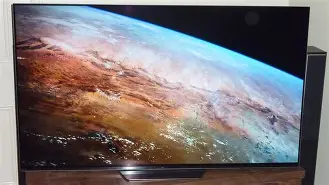
Motion and Processing: The Secret Sauce
In my experience, the way a TV handles motion is just as important as how it handles color. I’m sensitive to the "soap opera effect"—that hyper-smooth, artificial motion that makes movies look like home videos. What I found was that the motion handling here is arguably the best in its class. I typically keep the motion interpolation settings at their lowest or completely off, and the TV manages to maintain a filmic look without the stutter that sometimes plagues OLED panels due to their near-instantaneous response times.
Speaking of response times, I noticed a slight disappointment regarding gaming. While the input lag is low enough for casual sessions of Spider-Man or God of War, this isn't a "hardcore" gaming monitor. It lacks some of the modern 120Hz features found on newer models. For me, as someone who values the visual fidelity of a sprawling RPG over the frame-perfect requirements of a competitive shooter, it’s perfectly fine. But if you’re a high-tier FPS player, you might find the feature set a bit dated.
The Acoustic Surface Audio: A Genuine Surprise
I was skeptical about the "Acoustic Surface" technology—where the screen itself vibrates to produce sound. I assumed it was a gimmick that would rattle the glass or sound tinny. I was wrong. After using it for three months, I’ve found that the most impressive part is the "directionality" of the sound. When a character on the left side of the screen speaks, the sound actually seems to come from their mouth. It creates a much more immersive center-channel experience than traditional speakers hidden in the bottom bezel. While it can’t replace a dedicated subwoofer for that deep, floor-shaking bass, it is significantly better than any other built-in TV speakers I’ve ever heard. In fact, for casual news watching or YouTube, I often don't even turn on my external sound system.
The Software: A Love-Hate Relationship
After testing the interface for over 90 days, I have some honest findings about the operating system. It uses a standard smart TV platform that is very flexible but can be occasionally sluggish. I’ve noticed that after a week or two of heavy use without a full restart, the menus can start to lag, especially when jumping between heavy apps like Netflix and Disney+. I also found that the voice search feature is hit-or-miss; sometimes it’s lightning-fast, and other times it just spins a loading wheel for ten seconds before giving up.
One thing that bothered me was the sheer volume of "recommended content" on the home screen. I wish there was a way to strip it back to just my apps without the constant advertisements for shows I have no interest in. It feels a bit clunky compared to the hardware's sleek design. I ended up plugging in an external streaming stick to bypass the built-in UI, which solved the speed issue, but it feels like a shame to have to do that on a premium television.
Burn-In Concerns: A 3-Month Status Report
The "elephant in the room" with any OLED review is burn-in. I’ll be honest: I was nervous for the first month. I was constantly checking for faint outlines of news tickers or HUD elements from my games. After three months of varied use—including some long 4-hour sessions of games with static icons—I am happy to report zero signs of permanent image retention. I have been careful to keep the "Pixel Shift" feature enabled and I never leave the TV on a static menu for hours. Modern OLEDs have a lot of behind-the-scenes "pixel cleaning" that happens when you turn the set off, and so far, it seems to be working perfectly. In my experience, as long as you aren't watching the same news channel for 12 hours a day every single day, burn-in is much less of a threat than the internet would have you believe.
Pros and Cons
- Pro: Infinite Contrast. The ability to achieve true, absolute black elevates every single thing you watch, especially horror and sci-fi movies.
- Pro: Natural Color. The out-of-the-box accuracy is stellar; it doesn't suffer from the over-saturation common in many high-end displays.
- Pro: Acoustic Surface Audio. A legitimately innovative audio solution that makes voices feel tethered to the actors on screen.
- Pro: Thin Design. It looks incredibly premium and fits into a modern minimalist room aesthetic perfectly.
- Con: Peak Brightness. It struggles in very bright rooms with lots of natural sunlight; reflections can be a persistent issue during the day.
- Con: Low Stand Clearance. The pedestal is so low that almost any soundbar will block a portion of the screen if placed in front of it.
- Con: Software Lag. The built-in operating system can feel bogged down and sluggish compared to external streaming devices.
- Con: Gaming Limitations. Lacks some the latest high-refresh-rate gaming features, making it a "movies-first" device.
Comparison: A8F vs. Competitors
To give you a better idea of where this fits in the market, here is a breakdown of how the A8F compares to other display technologies and similar models I’ve used in the past.
Find top-rated TVs & Home Theater products at great prices.
See Deals →| Feature | A8F OLED | High-End LED/LCD | Entry-Level OLED |
|---|---|---|---|
| Black Levels | Perfect (Infinite) | Good (Deep Gray) | Perfect (Infinite) |
| Peak Brightness | Moderate (~600-700 nits) | High (1500+ nits) | Low (~500 nits) |
| Motion Processing | Excellent | Mixed (Depends on Brand) | Good |
| Built-in Sound | Superior (Screen Audio) | Average (Bottom Speakers) | Basic |
| Price Point | Premium | Mid-to-High | Upper-Mid |
Buying Guide: Is the A8F Right for You?
After living with this set, I think I can pinpoint exactly who should buy it and who should look elsewhere. In my experience, this TV is for the "cinephile"—the person who waits until the sun goes down to watch a beautifully shot 4K Blu-ray. If you value texture, atmosphere, and "correctness" in your images, you will be in heaven. The way it renders skin tones and subtle shadows in a dark room is something I haven't found on any other display type.
However, I would suggest looking at a high-end LED if your TV is going to be in a sunroom or a kitchen area with constant bright overhead lights. The A8F's beauty relies on contrast, and contrast is the first thing to go when ambient light washes out the screen. Furthermore, if you are someone who primarily uses their TV for competitive gaming on a PC or next-gen console, you might find the lack of certain variable refresh rate features frustrating for the long term. You're paying for the picture processor and the panel quality, not necessarily for the latest gaming bells and whistles.
Another thing to consider is your setup. If you aren't planning to wall-mount, measure your current soundbar height. If it’s more than 2 inches tall, you’re going to need to figure out a "riser" for the TV or prepare for a partially blocked view. It sounds like a small detail, but it was the single biggest physical annoyance I dealt with in the first week of ownership.
Final Thoughts and Conclusion
Three months later, do I regret the purchase? Not for a second. Every time I turn off the lights and put on a high-quality HDR film, I am reminded of why I spent the extra money. The "OLED jump" is real, and the A8F is a particularly refined version of that technology. It feels less like a gadget and more like a high-end piece of home theater equipment. I was surprised by how much I grew to appreciate the acoustic surface audio, and while I have my gripes with the brightness and the software speed, they are small prices to pay for the visual fidelity provided.
What I found was that the A8F demands a little bit of effort from the user—it wants a dark room, it wants high-quality source material, and it wants a bit of patience with its menus. But if you provide those things, it rewards you with arguably the best image you can get in a consumer living room. It has changed the way I experience media; I no longer just "watch" movies, I feel like I'm seeing them exactly as the director intended. If you are looking to upgrade from an older LED and you prioritize movie nights above all else, this is a phenomenal choice that holds up incredibly well long after the initial unboxing excitement has faded.