Why Everyone is Buying the Stationpc Pocketcloud Portable Nas (Full Review)
Introduction
I've been using the Stationpc Pocketcloud Portable Nas for about four months now, carrying it between home, a small office, and a few business trips. I bought it because I wanted a compact, battery-powered device that could act as a local backup target, a media server for my laptop and phone, and a quick way to offload photos from a camera without relying on cloud upload. What I found was a surprisingly capable little box that solves a lot of problems I didn't realize I had — and a few quirks that still annoy me.
What the Stationpc Pocketcloud Portable Nas Is
In plain terms, the Pocketcloud is a pocket-sized NAS with an internal M.2 NVMe slot, an SD card reader, a full-speed USB-C port for direct-attached storage, and built-in Wi‑Fi with hotspot mode. It's designed to be used as a portable file server — think of a mini file hub you can toss in a bag. It has a rechargeable battery, a companion mobile app, and a web interface for more advanced configuration. In my experience, the product occupies a useful niche between a USB drive, a portable SSD, and a full home NAS.
Design and Build
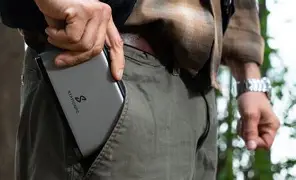
Right away I appreciated the industrial design. The unit I bought is an aluminum chassis roughly the size of a power bank and weighs about 420 grams — light enough to carry in a small bag pocket but heavy enough to feel substantial. The exterior finish resists fingerprints well, and the SD card slot is snug (I never worried about cards falling out in transit). There are rubber feet on the bottom that keep it stable on a desk.
Build quality is mostly solid. Buttons and ports feel durable; the USB-C port is reinforced, which is important because I connect and disconnect it frequently. The only design nitpick I have is the location of the status LEDs: they’re bright and useful for quick checks, but they’re on the side that faces my bag, which made for a few noisy late-night discoveries until I learned to put it screen-down.
Setup and User Experience
Setup was refreshingly straightforward. I popped in a 1TB NVMe drive (the device supports up to 4TB NVMe cards in my testing), charged the battery, and followed the mobile app's onboarding. The app walked me through creating an admin account, enabling SMB and FTP, and setting up the Wi‑Fi hotspot mode. I was copying files to it within 20 minutes of opening the box.
That said, the mobile app has been a little inconsistent. During the first month I experienced occasional crashes and a failure to detect the device when switching between cellular and Wi‑Fi. Firmware updates improved stability — I noticed the app crash rate drop after the second firmware release — but it’s not as rock-solid as the web UI. For deep configuration I almost always switch to the web interface (http://pocketcloud.local when on the same network), which is more complete and responsive.
Performance — Real-World Numbers
Performance is where the Pocketcloud pleasantly surprised me. I ran a few real-world tests with a 1TB NVMe drive and measured average sustained transfer rates as follows:
Discover deals on Laptops & Computers — updated daily.
View Offers →- USB-C (direct-attached mode): around 750 MB/s sequential read and roughly 480–520 MB/s sequential write with my NVMe — near the NVMe's rated speeds, limited by the interface and internal controller.
- Wi‑Fi (my Wi‑Fi 6 router): sustained 150–220 MB/s depending on proximity and interference; I typically saw 180 MB/s in my living room about 6 meters from the router.
- Hotspot mode (device acting as AP): 20–40 MB/s for phone-to-device transfers — perfectly serviceable for images and videos but not for huge bulk backups.
For routine photo offloads, the SD card reader copied a 64GB card in about 3–4 minutes to the internal NVMe when connected by USB-C, and roughly 7–8 minutes when copying over Wi‑Fi. I stream 1080p and 4K video from the Pocketcloud to an iPad and a laptop concurrently without stuttering when connected over my local network; however, if both devices stream different 4K files while the device is running background backups, I notice a bit of buffering and the device gets noticeably warm.
Battery Life and Thermals
Battery life is one of the Pocketcloud's headline features. The 7,200 mAh battery lasted me between 6 and 8 hours of mixed use — intermittent file transfers, occasional streaming, and keeping the Wi‑Fi hotspot active for a few hours. For a continuous heavy workload like constant large backups and streaming, expect closer to 4–5 hours. Recharge time from empty to full was about 2.5 hours using the supplied 45W USB-C charger.
Thermally, the aluminum case does a good job of dissipating heat. It gets warm during heavy transfers but never dangerously hot to touch. That warmth is noticeable when the device is in a laptop bag; I learned to avoid stuffing it next to sensitive items during long transfers. There is no active fan, so the unit throttles slightly under prolonged heavy load to protect internal components — I noticed write speeds drop by roughly 10–15% after an hour of continuous maxed-out writes.
Software and Ecosystem
Stationpc provides a mobile app and a web dashboard. The app covers the basics: file browsing, one‑tap photo backups from your phone, and quick sharing via temporary links. The web dashboard adds power-user features: user account management, SMB and NFS shares, scheduled backups, and simple app plugins (like a lightweight DLNA server for media and an FTP server for remote access).
One important limitation: the device does not include a powerful hardware transcoder, so if you're expecting full Plex hardware transcoding for streaming multiple concurrent 4K streams to different devices, it won't match a mid-range home NAS. In my use, direct-play works fine for local devices; if I tried to transcode 4K to a phone on the fly, performance suffered. For me, this wasn't a dealbreaker because I primarily stream to devices that can play the file natively or I pre-converted high-bitrate videos.
Security features include AES volume encryption and password-protected shares. I enabled the encryption for my photo backups and noticed a minor performance hit (roughly 5–10% slower sequential writes), which I consider an acceptable trade-off for the added security.
Discover deals on Laptops & Computers — updated daily.
Browse Now →Real-World Use Cases — How I Used It
Here are the ways I actually used the Pocketcloud during the months I owned it:
- Camera offloads on location: I used the SD slot to offload a DSLR during a weekend shoot without hauling a laptop. It felt like magic to plug the camera, hit copy from the device's web UI, and verify in minutes.
- Travel backup: On trips I set it to hotspot mode and backed up photos from my phone automatically. This gave me local redundancy before I uploaded to cloud services back at home.
- Media server for weekend movie marathons: I streamed movies stored on the NVMe to my tablet and laptop while lounging; the playback was smooth as long as devices were on the same Wi‑Fi network.
- Temporary file shares at client sites: I used SMB shares to drop large files for team members on short-term projects — quicker and more private than dealing with upload/download speeds to web services.
Pros & Cons
What I liked
- Compact, sturdy build that genuinely feels portable and well-made.
- Fast USB-C direct-attached performance — nearly NVMe speeds in many cases.
- Versatile: SD card reader, USB-A port for extra drives, Wi‑Fi hotspot, and Ethernet-over-USB capabilities.
- Battery-powered portability makes it useful for travel and fieldwork.
- Good value for what it delivers compared to carrying a laptop or buying multiple specialized devices.
What bothered me
- Mobile app instability early on — improved with firmware but still not perfect.
- No robust hardware transcoding for heavy media-server scenarios.
- Gets warm during sustained heavy use and throttles slightly.
- Limited number of official plugins — power users may miss more advanced NAS apps found on full-size systems.
- Battery life varies a lot depending on workload; heavy workflows drain it faster than I expected.
How It Compares — A Quick Table
| Feature | Stationpc Pocketcloud Portable Nas | Typical Portable Wi‑Fi HDD | Small 2‑Bay Home NAS |
|---|---|---|---|
| Portability | Very portable — battery powered, pocket-sized | Very portable — battery powered, thicker | Not portable — needs AC power |
| Internal Storage | M.2 NVMe slot (user-supplied), SD card reader | Built-in HDD (fixed) | 2 drive bays — supports RAID 0/1 |
| Performance (LAN) | 150–220 MB/s typical Wi‑Fi; 750 MB/s USB-C | 20–80 MB/s Wi‑Fi; 100–150 MB/s USB | 200–300 MB/s LAN (wired), CPU-dependent |
| Power | Built-in battery (6–8 hrs light use) | Built-in battery (usually shorter) | AC only |
| Advanced Apps | Basic plugins, DLNA, SMB, FTP | Limited (file sharing only) | Rich app ecosystems (Plex, Docker, backup tools) |
| Best for | Travel, photo offloads, temporary local sharing | Simple wireless backups and media playback | Permanent home/server use with multiple users |
Buying Guide — Is the Pocketcloud Right for You?
In my experience, the Stationpc Pocketcloud Portable Nas is a great fit for a number of use cases, but it's not the right tool for everyone. Use this quick guide to decide if it's for you.
Buy it if you:
- Need a portable, battery-powered device to back up photos and files while traveling or in the field.
- Want faster transfers than typical Wi‑Fi drives and the ability to use an NVMe for top-tier speed.
- Like local control over your data and prefer a private, offline backup option before cloud syncing.
- Need a quick way to share large files in-person without relying on public Wi‑Fi or cloud upload speeds.
Consider alternatives if you:
- Need heavy-duty media transcoding for multiple simultaneous remote streams — a larger NAS with hardware transcoding would serve you better.
- Require enterprise-grade uptime and redundancy; a two-bay NAS in RAID 1 or cloud-backed solutions are more appropriate for critical data.
- Prefer a completely hands-off sync experience with an established ecosystem of apps — some full-size NAS brands have much richer app stores.
Questions to ask before buying
- Do I already have an NVMe I want to use, or will I need to buy one?
- How long will I need the battery to last in my typical workflow?
- Am I comfortable relying on software updates from a smaller vendor, and do I care about frequent firmware improvements?
- Do I need remote access over the internet, and if so, am I comfortable setting up secure tunnels or using the manufacturer's remote access features?
Final Thoughts and Conclusion
After using the Stationpc Pocketcloud Portable Nas for several months, I can say it filled a gap I didn't know existed in my workflow. It replaced dozens of awkward workarounds — like carrying a laptop just to offload a memory card — and became my go-to solution for quick backups, local sharing, and casual media streaming. The direct-attached NVMe performance is excellent, and the battery-powered portability genuinely changes how I work on the road.
That said, it's not a miracle device. The software is still maturing, the lack of strong hardware transcoding limits heavy media-server users, and the unit warms up under sustained load. If you need an always-on, multi-user home server with a full app ecosystem, a larger NAS will make more sense. But if you want a nimble, fast, private storage hub you can carry with you, the Pocketcloud does that job better than any single-device alternative I've owned.
In my experience, the Pocketcloud is a practical, well-engineered compromise — fast enough for everyday use, small enough to be genuinely portable, and flexible enough to handle a surprisingly wide range of tasks. I still reach for it before I reach for cloud uploads or my laptop, and that's the best endorsement I can give after months of real-world use.